
The AI at Duke Initiative is harnessing the power of artificial intelligence to achieve research breakthroughs that could save lives. But artificial intelligence as a concept goes back to the early 1950s. Chess was one of the earliest areas of experimentation with artificial intelligence. Chess may be a complicated game, but the possible moves are finite, and the rules can be programmed. Computing pioneer Alan Turing created a theoretical chess-playing program in 1948 that required more computing power than existed at the time.
In 1972, Tom Truscott ’75, A.M.’81 and Bruce C. Wright ’75, decided to experiment with creating a computer program that could play a game of chess. The Chronicle reported that they were influenced by the famous Bobby Fischer-Boris Spassky chess match, the so-called Match of the Century. Truscott and Wright developed a program they called DUCHESS (Duke University CHESS), advised by computer science faculty member Dietolf Ramm. They debuted it at the Association for Computing Machinery national tournament in San Diego in 1974. Jonathan Ingram ’76 of The Chronicle reported the results with the unforgettable opening paragraph, “Merk, znarx, bop . . . checkmate! Ahh, nothing like the familiar sounds of a computer chess tournament to soothe the soul.” He noted that DUCHESS beat the Massachusetts Institute of Technology’s Tech II program but was forced to resign against powerhouse Northwestern University program Chess 4.0. At that time DUCHESS could evaluate about 1,000 different boards before making each move, and it “attempted to simulate in some ways the thought processes of expert players in that it formulated plans of attack and searched for move sequences to carry out its plan.”
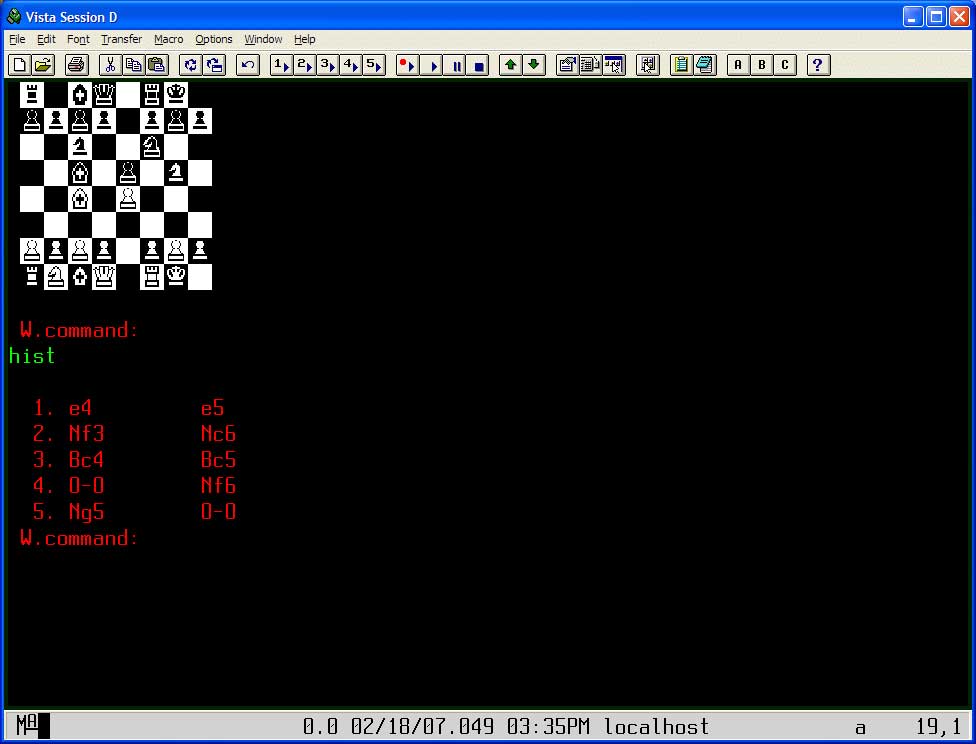
Buoyed by their early success, Truscott and Wright continued to compete with DUCHESS. They fully overhauled it in 1977 with the assistance of graduate student Eric Jensen, advised by computer science faculty member Alan Biermann. Jensen and Truscott had created a checkers program together, and used that as a basis for the improved DUCHESS. It reviewed a much larger number of possible boards – 100,000 before each move – and spent much less time on selection. The computing power was provided by the Duke University Computing Center, which linked up to the Triangle Universities Computing Center. Using DUCC’s IBM System 370, Model 178 “connected by microwave” to TUCC’s IBM System 370 Model 165 mainframe system, these machines offered 1 to 4 million bytes of computing power, a vast sum in the 1970s, but as a point of comparison, the 128GB iPhone in your pocket has about 128 billion bytes.
In 1977, the new and improved DUCHESS tied with Northwestern’s Chess 4.6 in the national competition and, perhaps due to the slower computers available to all contestants, won an international invitational held in Jerusalem that same year finally defeating Northwestern, which typically used the fastest machine available. A report in the artfully named “Data Dump,” produced by the Duke University Computational Center, reported, “Large display chess boards were set up in the tournament room so that they would be easily visible to the audience, and the two competing teams associated with each board set up computer terminals nearby which could communicate by phone lines to computers in Israel.” This represented the apex of DUCHESS’ success. They finished second in the world championship in 1977, and third in the 1980 world championship. In 1981, DUCHESS placed fifth in the North American championship. However, there were other computing explorations afoot: Truscott, along with Jim Ellis ’78, A.M.’83, started Usenet, a news and message sharing system that predated the world wide web, which was used internationally for decades.
In a 1978 Chronicle article, Dan Doernberg ’80 noted that “Tom Truscott, one of the principal authors of Duke’s computer chess program, is convinced that automation will prove beneficial to humankind. Truscott said computers can perform tremendous services by freeing human beings from the drudgery of many occupations and tasks.” Within the strict confines of a chess game and the limits of 1970s computing technology, artificial intelligence was under exploration by Duke faculty and students well over 50 years ago. Our current exploration of AI tools promises important innovation and discovery, less drudgery – and maybe a little fun, too.
For more information about Duchess and its software, see https://www.chessprogramming.org/Duchess