
Some people find their purpose early in life. Others fall into their calling. Uzo Ayogu ’17 did both.
Growing up in South Africa, Ayogu knew from a young age that he wanted to get a world-class engineering degree in the U.S. and bring those practical skills back to make an impact in Africa. Indeed, his Duke application essay was about starting a nonprofit in Nigeria.
“I’ve always been really interested in how to create shared prosperity in Africa,” he says.
Once at Duke, Ayogu jumped into every opportunity, spending his freshman summer working on a rainwater catchment engineering project with DukeEngage in rural northern Togo, in West Africa. He spent his second Duke summer working in rural northern Brazil with Duke Engineers for International Development.
In his sophomore year, Ayogu had the good fortune to meet Carmichael Roberts ’90, Ph.D.’95, an alumnus and Duke University trustee. Like Ayogu, Roberts is a scientist and engineer, as well as an Alpha Phi Alpha Fraternity brother. But it was Roberts’ background as a successful entrepreneur-investor and co-founder of multiple ventures that made him an invaluable contact. Roberts took Ayogu under his wing and served as a mentor.
“Uzo is exactly the kind of student I like to see at Duke,” said Roberts. “Someone who’s very capable academically and could do anything for a living, but who wants to do work to help humanity.”
True to form, in his junior year Ayogu helped launch Releaf Earth, an organization that connected Nigerian farmers with technology to process palm kernel oil as a revenue stream.
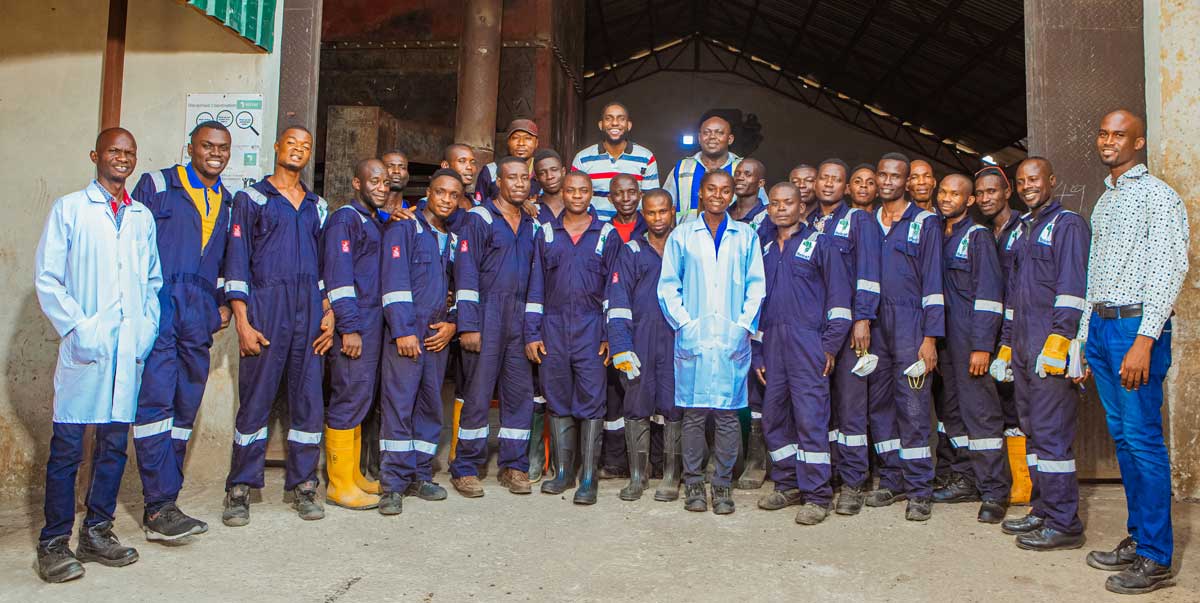
In Ayogu’s senior year, Microsoft offered him his dream job as a project manager in Seattle. “Taking that job would have been the safe, logical thing to do, but he had this burning entrepreneurial humanitarian passion he wanted to see through,” Roberts said. Ayogu wound up declining the offer, jumping full-time into Releaf Earth, and moving to Nigeria with his fellow co-founders in September 2017.
Releaf’s first success was developing the Kraken, a portable, patented palm nut deshelling technology for the vegetable oil industry. The equipment cracks palm nuts 200 times faster and with better quality than deshelling by hand.
UZO AYOGU
- Born in Nigeria to an American mother and Nigerian father but grew up in South Africa.
- Active with the Fuqua alumni community in Nigeria, where he mentors Duke undergrads and recent graduates.
- Served as a Duke Young Trustee from 2017 to 2020.
After a few years, it became clear that, while enormous efficiencies for palm nut farmers were achieved, the Releaf model was not profitable enough to scale. But Ayogu’s co-founder Ikenna Nzewi realized that the waste produced in the deshelling process could be valuable.
Heating the shells in a low-oxygen environment produces biochar, or biological charcoal, which significantly boosts the fertility of soil and can increase crop yields by 25 to 40 percent. Biochar also draws carbon from the atmosphere, and keeps it trapped in the ground, preventing its release into the atmosphere as carbon dioxide. Operations that produce biochar can generate revenue by selling carbon removal credits to businesses that need to offset their own carbon production.
“When Ikenna sent me the biochar idea, it sounded too good to be true,” says Ayogu.
The team spent a few months validating that the biochar angle was a good one. Within 12 months, Releaf had pivoted to became Nigeria’s first industrial biochar producer and began issuing carbon removal credits, which are worth $100 to $200 per metric ton. The move increased the company’s value tenfold.
“Instead of Africa playing catch-up with other countries, we saw that we could actually be world leaders in nature-based, high-quality, durable, carbon dioxide removal,” Ayogu says.
Over the years, Roberts and Ayogu continued their mentor-mentee relationship and eventually became good friends. Roberts was even on hand in May when Ayogu married his longtime love, Leah Azeze, in South Africa.
“Uzo is exactly where he should be. He is a successful entrepreneur and is doing something substantive for humanity. I can’t wait to see what he does next,” Roberts says.
Releaf’s ambitions continue to grow. It has more than 100 employees across 20 Nigerian states and expects to create more than 500 jobs within the carbon removal industry, while reaching more than a million farmers. By 2030, the company aims to remove up to 700,000 metric tons of carbon dioxide equivalent, recycle 50,000 metric tons of waste biomass, and produce 20,000 metric tons of biochar each year.
For Ayogu, the organization’s success is a dream realized. “We just had this belief that our generation would be the leaders we’ve been waiting for. But we wouldn’t develop leadership capacity until we got started and got our hands dirty,” he said.
Using those metrics, Ayogu has fully accomplished his mission.
Ayogu invites any alumni who are on sustainability teams or want to learn more about carbon sequestration to reach out to him.