
Bailey Chase ’95 is one of those actors that TV lovers know about. He’s familiar from a string of memorable performances in popular shows: “As the World Turns,” “Buffy the Vampire Slayer,” “Ugly Betty,” “Saving Grace,” “Damages,” “Longmire” and “24: Legacy,” to name just a few. Alumni from the early ’90s may remember him as Bailey Luetgert (Chase is his middle name), No. 31 in the Duke secondary in the 1995 Hall of Fame Bowl. Today you can see him in Angel Studios’ “Homestead,” a movie-turned-TV series about a group of survivors of a nuclear attack living together in a fortified mountain compound. Don’t expect zombies. “Homestead” is about family and community rather than post-apocalyptic mutants. Born in Chicago, Chase grew up in Florida and is among the many notable graduates of the prestigious Bolles School, where his roommate was Atlanta Braves Hall of Famer Chipper Jones. During the upheaval of Covid, Chase, his wife, Amy, and their three kids moved to the mountains of North Carolina, Amy’s home. Living a short drive from the Asheville airport makes for an easy commute to movie and TV sets across the country, where he often plays a good guy in a cowboy hat. But Chase’s favorite role is clearly that of family man, an identity he relishes, back at home.
DukeMag: Tell us about “Homestead.”
Bailey Chase: Well, commercially, I’d say it’s the right film at the right time. It’s about faith, family and building community. My character, Jeff Eriksson, is this former special operator who gets thrown into a post-apocalyptic situation, and it’s all about protecting his family and everyone else within the homestead.
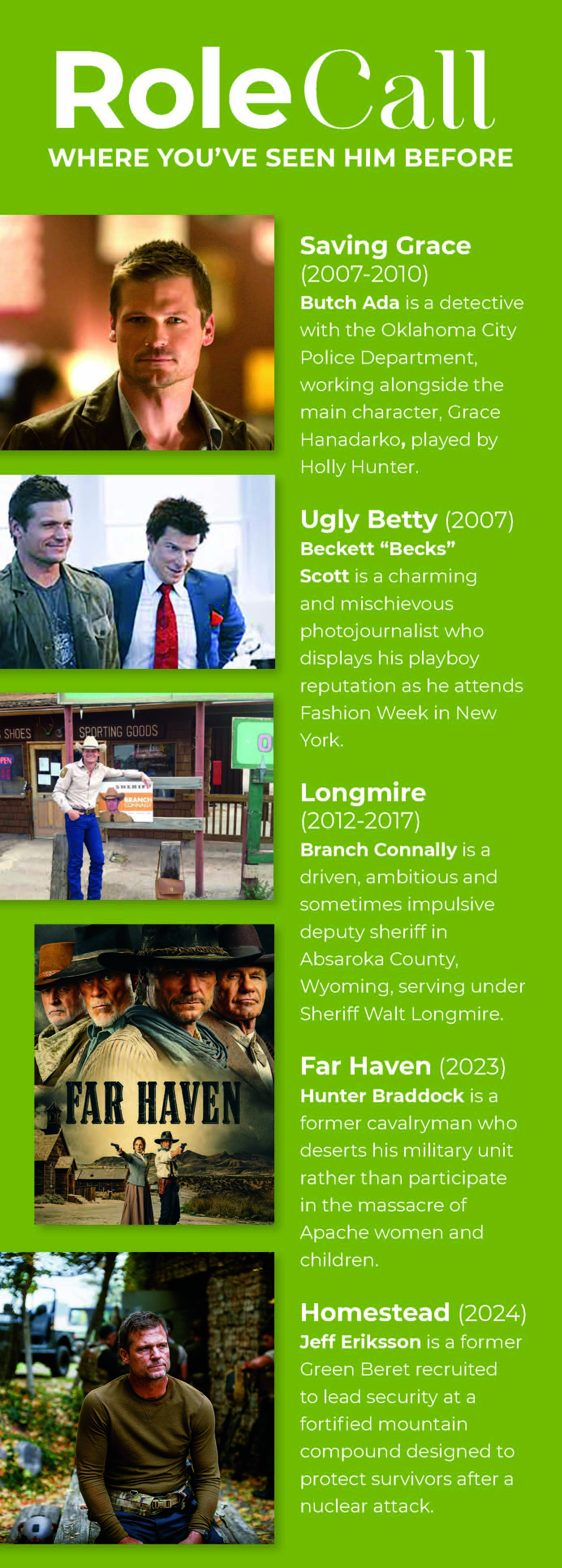
DM: How is Jeff Eriksson different from your many previous roles?
BC: I hone in a little bit more on the flaws now. That’s more fun to play as an actor. Butch in “Saving Grace” was great, but he pretty much had it all – or he thought he had it all – figured out. And Branch had it all figured out, until he didn’t, in “Longmire.”
DM: It doesn’t end well for Branch, as I recall.
BC: Yeah, the cool thing about that was that my character had the blinders on. You know, the audience could see what was going to happen, and they’re like, “Oh, no!” But Branch didn’t see it coming. I feel like I did good work on that one.
DM: You left Los Angeles in 2021 to move to North Carolina. How did that come about?
BC: So Amy, being from the mountains of North Carolina, always had it in the back of her mind that she’d go back home one day. We didn’t know how or when. Things started to not work in LA during Covid – they shut down the schools, there were no sports for the kids. Really, no life, no work. And it became more and more obvious that we should leave LA. Amy’s very close with her parents, who are in N.C. So we’re now back here. Everything’s about seven minutes away: school, the in-laws, the grocery store, golf course, soccer field. It’s a great location. We live in a house that would not have been affordable in LA. It’s a kid’s dream. There’s a sports court and a pool. We have two golden retriever puppies so it’s a full and lively house.
DM: Sounds like it was the right decision.
BC: It seemed like a hard decision at the time to, you know, give up on that dream, or so I thought, and follow my heart. But we haven’t looked back. And then work has taken off again. You know, I was more of a TV guy when I was out in LA. And then I started doing these movies. It started with Christmas movies – because I just needed to make money – and then westerns. That all led to working with Angel, and then there was “Homestead.” I think the best success comes when you don’t chase it, and that’s what I’m finding now.
DM: You seem comfortable in the role of family man …
BC: Family is No. 1 to me. My parents divorced when I was 2, and we moved to Florida when I was 4. I was pretty much raised in Florida, but we would go back [to the Chicago area] to see my cousins and grandparents. My brother and I would play baseball and ride horses. We swam and learned how to water ski on the lakes of Illinois.. I have so many great memories. And so I want that for my children, and that wasn’t really attainable out in LA.
DM: How did you find your way to Duke?
BC: Florida’s different, and it’ll always be home. But I couldn’t wait to get out. I wanted to experience more of the world. But I was also really close with my mom, who is now passed, so I didn’t want to go too far away. I was looking at all the schools in the old version of the ACC. Georgia Tech, Virginia, Wake Forest, Chapel Hill and Duke were my five visits, and Duke recruited me hard in baseball as well, so that definitely had something to do with it. When Duke offered, my dad was like, “Well you have to take it. Duke’s offering you a scholarship. You have to go.” And I was kind of surprised because it wasn’t his deal to give me advice, or to tell me to do something. And so that was like a defining moment. And I said, “OK, Duke it is.”
DM: How did your time at Duke prepare you for today?
BC: You know, it’s not our first rodeo, so to speak. We’ve been around the block, and I’m a big believer in things happening for a reason. There’s a bigger plan at play, and we just need to show up every day and to keep going. Acting is a roller coaster for sure. And on some of the downswings, I’d just look
myself in the mirror and tell myself to keep going. And I definitely attribute that mindset to my football days at Duke. You know, where it was about 99 degrees and 98% humidity. And we’re out there on the practice fields, and maybe our season wasn’t going as well as we wanted it to. It just builds fortitude and tenacity, and all those things that you need to succeed in life.